
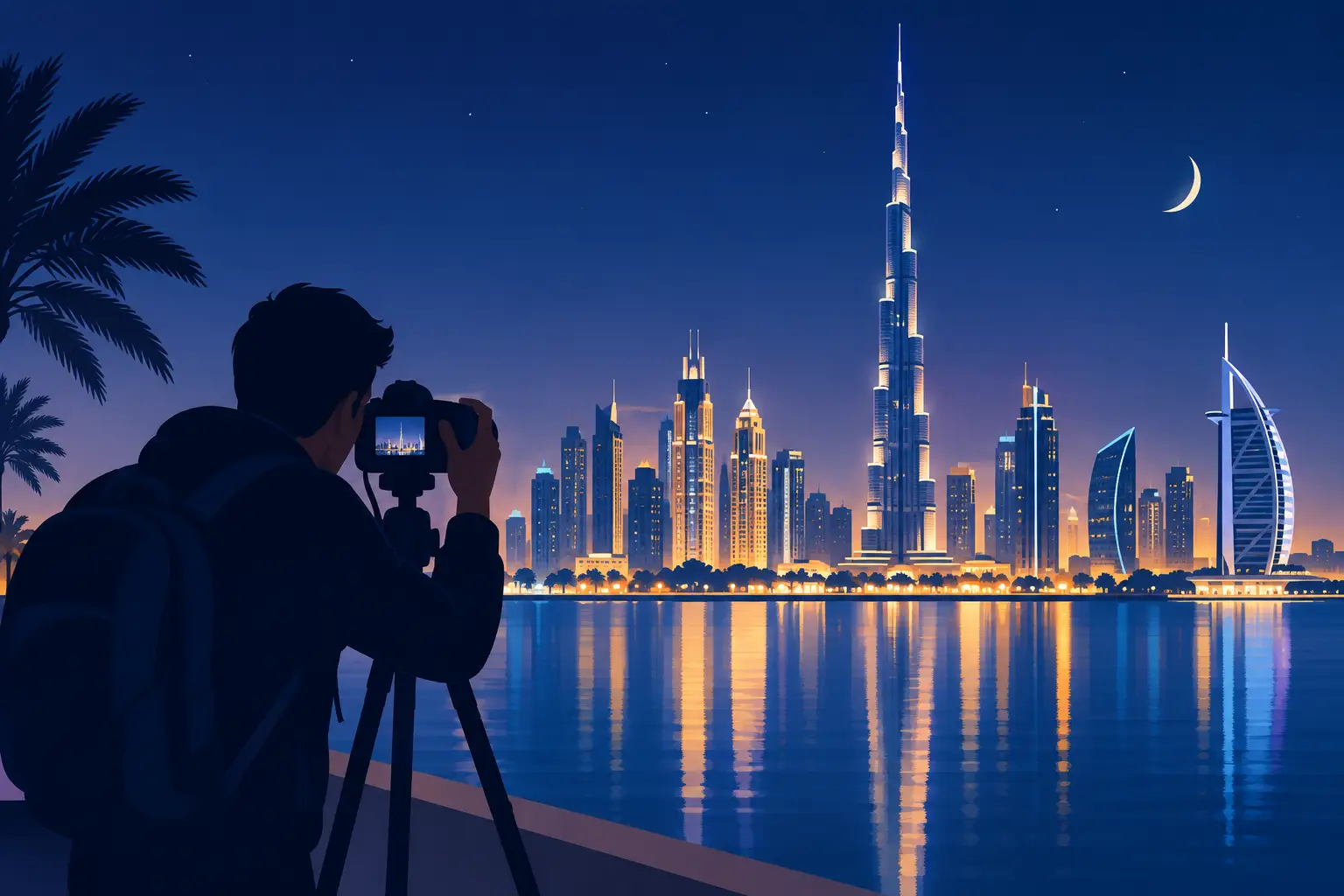
Dubai changes character after sunset. The heat softens, towers begin to sparkle, fountains and waterfronts reflect the city’s color, and the desert turns quietly dramatic beneath a wide Arabian sky. Dubai night photography is not only about recording famous landmarks. It is a chance to capture the contrast that makes this destination unforgettable: futuristic skylines, old-city textures, lively marinas, and golden dunes only a short drive apart.
For travelers, the best results come from planning around light, location, and timing rather than carrying the most expensive camera. A phone can create striking images in the right setting, while a mirrorless camera or DSLR gives more control for long exposures, action, and low-light portraits. Either way, Dubai rewards the photographer who stays out a little longer.
Plan Your Dubai Night Photography Around Blue Hour
The most flattering light often arrives before full darkness. Blue hour is the short period after sunset when the sky remains a deep blue while building lights, street lamps, and hotel façades begin to glow. In Dubai, this is a beautiful window for skyline images because the scene keeps detail in both the sky and the city.
Arrive at your chosen viewpoint before sunset. You can photograph the warm transition of daylight, then adjust as the city lights come on. This approach is especially useful around Downtown Dubai, Dubai Marina, and the waterfront areas, where reflections become richer once the sky darkens.
After blue hour, Dubai is still highly photogenic, but exposure becomes more challenging. Bright signage and white architectural lighting can easily lose detail, while shadows turn very dark. Lower your exposure slightly if the brightest areas look washed out. A little underexposure is usually easier to correct than a completely blown-out skyline.
The Best Night Scenes to Capture in Dubai
Downtown Dubai and the Burj Khalifa
The Burj Khalifa is the obvious icon, but it does not have to produce an obvious image. Instead of shooting only from directly below, look for framing through palms, surrounding architecture, or a distant promenade. A vertical composition emphasizes its incredible height, while a wider image can show how the tower rises above the energy of Downtown Dubai.
For travelers photographing with a phone, use night mode but keep the device steady against a railing or small tripod. With a camera, begin around ISO 100 to 400, use a narrow aperture such as f/8 to f/11, and experiment with longer shutter speeds. A tripod helps turn moving headlights and water into smooth lines of light.
Dubai Marina and JBR
Dubai Marina brings together illuminated high-rises, yachts, restaurants, and water reflections in one lively setting. It works especially well for couples and friend groups because you can combine atmospheric city images with natural travel portraits. Position your subject near a source of soft ambient light, such as a shopfront or waterfront lamp, rather than placing them directly under a harsh overhead light.
JBR adds a more energetic beachside mood. The city lights, passing cars, and open pedestrian areas create a sense of movement. This is a strong choice for travelers who want Dubai to feel glamorous and social rather than quiet and architectural.
Dubai Creek and Al Seef
For a different side of Dubai at night, head toward Dubai Creek and Al Seef. The area offers traditional-style lanes, wooden abra boats, warm lantern light, and water views that feel far removed from the glass towers. It is an excellent setting for details: patterned doorways, Arabic-inspired architecture, tea glasses, market textures, and silhouettes along the creek.
This is also where restraint matters. The charm comes from the atmosphere, so avoid using a powerful flash that flattens every surface. Raise your ISO carefully, stabilize your camera, and let the warm lights remain warm. A slightly grainy photo can feel more authentic here than an over-processed image.
The Desert After Sunset
A desert safari offers one of the most memorable settings for Dubai night photography. The final color of sunset often gives way to deep violet skies, glowing camp lanterns, firelight, and sweeping dune silhouettes. The desert has less light pollution than the city, but it also changes fast after dark, so prepare your settings before the sun disappears.
A guided evening desert experience makes the timing easier. You can photograph dune bashing routes and camel rides in the last light, then focus on camp scenes during dinner and live entertainment. Premium packages can be especially worthwhile for travelers who want a more relaxed setup, additional activities, or extra time to photograph the surroundings without rushing between locations.
For desert portraits, use the camp lights as part of the composition. Frame a person beside a lantern, against a glowing tent, or in front of a fire-lit performance area. Avoid stepping away from designated camp spaces after dark, especially in unfamiliar dunes. The desert is breathtaking, but safe, guided access should always come first.
Palm Jumeirah and Waterfront Skylines
Palm Jumeirah offers broad views, luxury hotels, and dramatic city perspectives. The waterfront is particularly rewarding when wind is low and the water holds a clean reflection. If you are photographing from a moving boat or cruise, skip very long exposures and instead raise ISO enough to keep your shutter speed fast. A sharp handheld image is better than a blurry long exposure when the deck is moving.
The Palm also suits wide-angle compositions. Let the illuminated curve of the shoreline lead the eye toward the skyline, or use a hotel façade and palms to add depth in the foreground.
Camera Settings That Work After Dark
There is no single perfect exposure for Dubai at night. A brightly lit landmark needs different settings from a moonlit dune or a dinner show. Still, a few starting points will help you work confidently.
For a cityscape on a tripod, try ISO 100, f/8, and a shutter speed between one and 10 seconds. Check the highlights, then shorten the exposure if lights appear too bright. For handheld street scenes, use a wider aperture such as f/1.8 to f/2.8 if available, raise ISO to 800 or 1600, and aim for a shutter speed of at least 1/60 second. If people are walking or performing, 1/125 second or faster is safer.
Phone photographers should clean the lens first, turn on night mode, and hold the device still until the exposure finishes. Do not zoom digitally into distant landmarks. Move closer when possible, or crop later. A small portable tripod can make a dramatic difference for both phones and cameras.
Compose for the Energy of the City
Dubai’s nighttime appeal comes from scale, contrast, and color. Use leading lines from boardwalks, roads, railings, and marina edges to direct attention toward the main subject. Include a person in wide skyline shots when you want to show the size of the architecture. A small figure in front of the Burj Khalifa or on a dune ridge gives the image a stronger sense of place.
Reflections deserve patience. Stand low near the water when it is safe to do so, and wait for boats or crowds to move through the frame if they distract from the scene. Conversely, a passing abra, yacht, or vehicle can add a purposeful streak of motion when your shutter is slow.
Avoid trying to photograph every landmark in one evening. Downtown, Marina, Creek, and the desert each have their own pace. Choosing one or two zones lets you enjoy the experience while finding stronger angles.
Respect Rules, Privacy, and the Conditions
Dubai is welcoming to visitors, but photography should always be considerate. Do not photograph people closely without permission, particularly families, children, or anyone in a private setting. Be cautious around government buildings, transport facilities, security areas, and private properties. If a venue or attraction restricts tripods, follow the rule and use a compact support only where permitted.
Heat may be lower at night, yet humidity can still fog a lens near the coast. Carry a microfiber cloth, spare battery, and enough storage space. Sand can also be tough on equipment during desert outings, so change lenses sparingly and keep gear protected in a closed bag.
The most memorable Dubai night photographs are usually made when the camera supports the moment instead of interrupting it. Watch the last light fade over the dunes, enjoy the city’s reflections on the water, and give yourself time for one more frame. That extra pause is often where the magic of Arabia appears.