
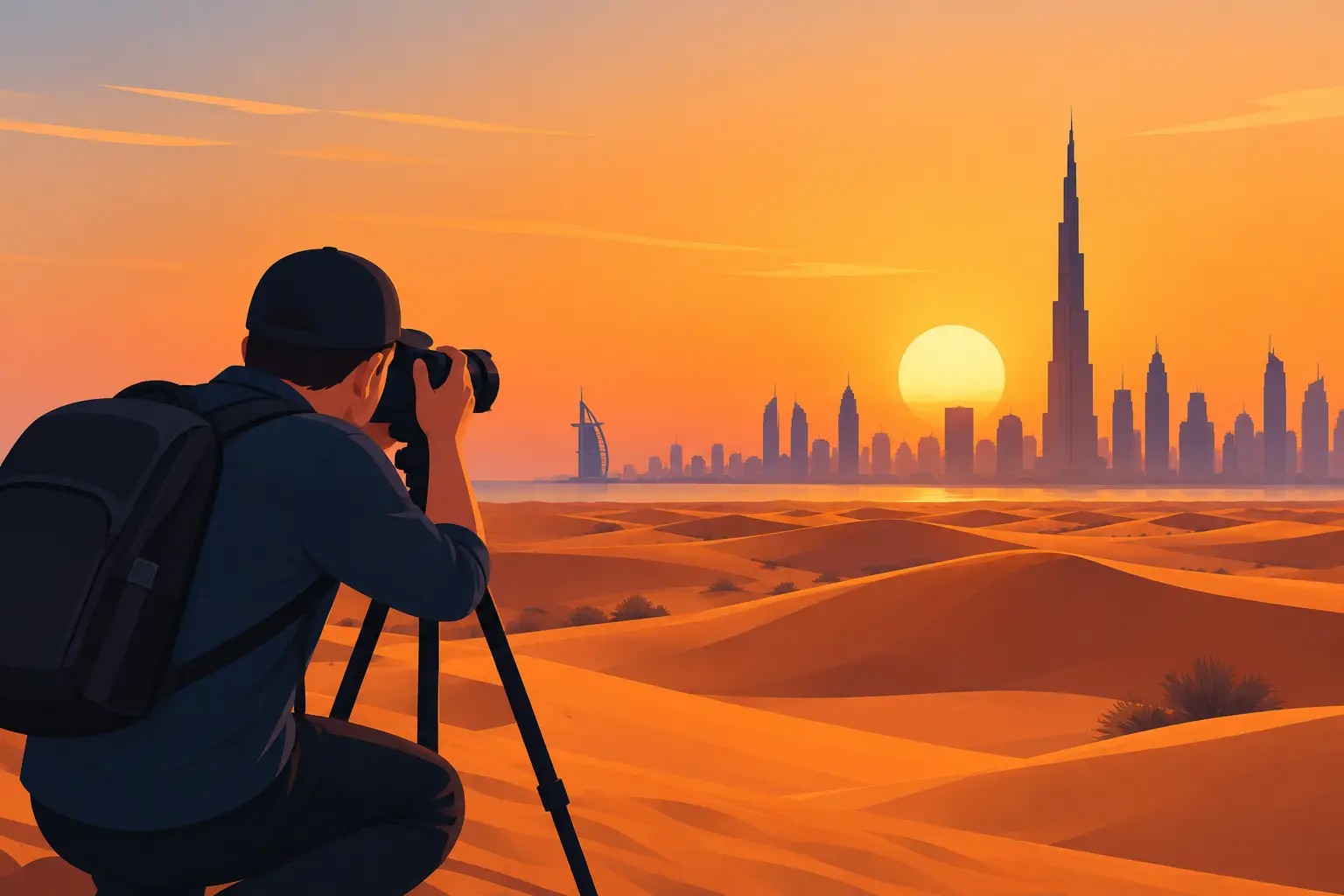
The best time to capture desert sunset photos is often the few minutes when everyone else is watching the sun disappear. The dunes shift from gold to copper, the sky softens from bright blue to peach, and every footprint gains texture. On a Dubai desert safari, that brief window can turn a quick vacation snapshot into one of the defining images of your trip.
You do not need a professional camera bag or advanced editing skills to make the most of it. You do need to understand the changing light, arrive ready before the stop, and use the desert itself as part of the composition. Here is how to photograph the magic of Arabia with confidence, whether you bring a phone, a compact camera, or a DSLR.
Plan Your Desert Sunset Photo Moment
A desert sunset does not happen on a fixed schedule for every safari itinerary. Pickup times, dune-bashing routes, seasonal daylight, and camp arrival plans can all affect when your guide pauses for photographs. In winter, the sun sets earlier; in summer, sunset arrives later, although the heat makes the afternoon light feel more intense.
Check the sunset time for your travel date, then make sure your camera or phone is charged well before pickup. A portable battery is useful, especially if you have been filming dune bashing, camel rides, or sandboarding throughout the afternoon. Clear space on your phone too. The desert rewards experimentation, and you will want room for more than one take.
If you are on a guided safari, listen when your guide announces the sunset stop. This is not the moment to search through a backpack for a lens cap or figure out portrait mode. Have your device in hand, clean the lens with a soft cloth, and step out carefully when instructed. Vehicles, ridgelines, and loose sand require awareness, even when the view is breathtaking.
How to Capture Desert Sunset Photos With Better Light
The sun is remarkably bright until it reaches the horizon. If you point straight at it, your camera may produce a washed-out sky, a dark foreground, or both. That can be dramatic when done intentionally, but it is not the only way to tell the story of the desert.
Start by photographing with the sun slightly to one side rather than directly in front of you. This side light brings out the ripples in the dunes and adds depth to the sand. Walk a few paces along the ridge, if your guide says it is safe, and watch how quickly the patterns change. A small change in angle can make a flat scene feel layered and cinematic.
For a classic silhouette, place your subject between the camera and the setting sun. Ask them to stand on the crest of a dune, keep their arms slightly away from their body, and hold still. A flowing dress, a scarf lifted gently by the breeze, or the outline of a camel can create an unmistakably Arabian scene. Tap the brightest part of the sky on a phone screen, then lower the exposure slightly until the person becomes a clean, dark shape.
For portraits where you can still see faces, turn your subject away from the sun and use the bright sky as a soft backlight. Move close enough for a waist-up frame, then tap their face to focus. If your phone offers exposure control, raise it a little. The sky may become paler, but you will preserve the warmth in skin tones and clothing.
Do not pack up the second the sun drops below the horizon. The color often improves afterward. This period, sometimes called the blue hour, can bring violet, pink, and deep amber tones to the sky while the dunes hold their remaining warmth. It is an especially beautiful time for wider scenes of your safari camp, distant vehicles, or a camel caravan returning across the sand.
Build a Composition That Feels Like Dubai’s Desert
The most memorable desert images usually have a strong subject, not just a beautiful sunset. The sun and dunes are the setting. Your travel companions, a camel, a guide in traditional dress, or the sweeping curve of a dune can give the photo a sense of scale and place.
Look for leading lines. Wind-shaped ridges, tire tracks, and the shadow edges of dunes naturally guide the eye toward the horizon. Rather than placing the horizon in the middle of the frame every time, try putting it in the upper third when the sand texture is the star. Put it in the lower third when the clouds and color are the main attraction.
Scale is particularly important because desert landscapes can look smaller in photos than they feel in person. Place one person near the top of a dune, but not directly against another dark ridge behind them. Their outline will be clearer against the bright sky. If a camel ride is part of your experience, photograph the animal and rider in profile, leaving open space in front of them so the image feels like it is moving into the landscape.
Avoid trying to fit every dune into one shot. Wide images are magnificent, but close details can be just as evocative: bare feet leaving prints in cool sand, hennaed hands holding a scarf, a falconer’s glove, or sunlight catching the edge of an Arabic coffee cup at camp. These details make a travel album feel personal rather than postcard-perfect.
Use Simple Settings for Cameras and Phones
For most travelers, speed matters more than technical perfection. Light changes quickly, and your group may be ready to continue the adventure. Use settings that let you react without overthinking.
If you are using a camera, begin with aperture priority or program mode. An aperture around f/8 is a dependable starting point for wide landscapes because it keeps much of the scene sharp. For portraits, use a wider aperture such as f/2.8 to f/4 if your lens allows it, which softens the background and places attention on your subject.
These four adjustments are worth knowing:
- Keep ISO low, ideally ISO 100 to 400, while there is still enough light. This helps preserve smooth color in the sky.
- Use a faster shutter speed, such as 1/500 second or quicker, for walking camels, moving scarves, or action on the dunes.
- Try exposure compensation at minus 0.3 to minus 1 when the sunset looks too pale. Slight underexposure often protects the sky’s color.
- Shoot in RAW if you know you will edit later. If not, JPEG is completely fine and easier to share right away.
On a smartphone, turn on grid lines and use the main rear camera rather than digital zoom whenever possible. Tap and hold to lock focus and exposure if your device supports it, then slide the exposure control down a touch for richer skies. Portrait mode works well for close images of people, but standard photo mode is usually more reliable for silhouettes and wide desert scenes.
A tripod is helpful for blue-hour landscapes, but it is rarely essential on a safari. Rest your camera on a stable surface only when permitted, or brace your elbows against your body. Do not rush toward a dune edge for a lower angle. Sand can give way, and no photograph is worth ignoring your guide’s safety instructions.
Make the Most of a Guided Safari Stop
A professionally designed desert experience gives you more than transportation into the dunes. It gives you local timing, safe stopping points, and a guide who understands where the view opens up. Let them know early if sunset photographs are a priority, particularly if you are celebrating a proposal, anniversary, birthday, or family trip.
Your guide may be able to suggest the best side of a dune for the available light or allow a little extra time once the group has finished taking in the view. Be considerate of fellow travelers, though. Take your hero shot, then step aside so everyone has space to enjoy the moment.
Seven Tours Dubai safari experiences pair this photography opportunity with the bigger desert story: thrilling dune bashing, camel rides, cultural moments, dinner, and evening entertainment. Photograph the transition between them. The final glow on the sand before camp lights appear can become a beautiful visual memory of a full Arabian evening.
Edit for the Feeling, Not an Unreal Sky
A light edit can bring a sunset photo closer to what your eyes remember. Start by lowering highlights to recover bright areas around the sun, then lift shadows gently if your foreground has gone too dark. Add a little warmth and contrast, but stop before the orange becomes artificial.
Be careful with heavy saturation. Dubai’s desert already has extraordinary natural color, and overly intense edits can erase the soft tonal changes that make sunset special. If the image feels flat, try adding contrast or clarity to the sand rather than pushing every color slider. For portraits, keep skin tones natural, even when the horizon is glowing red.
The finest desert sunset photograph is not always the one with the largest sun or the brightest sky. Often, it is the image that brings you back to the warm sand underfoot, the hush after the engines stop, and the people beside you as daylight fades. Keep your camera ready, then take a moment to put it down and watch the Jewel of the Desert change color with your own eyes.