
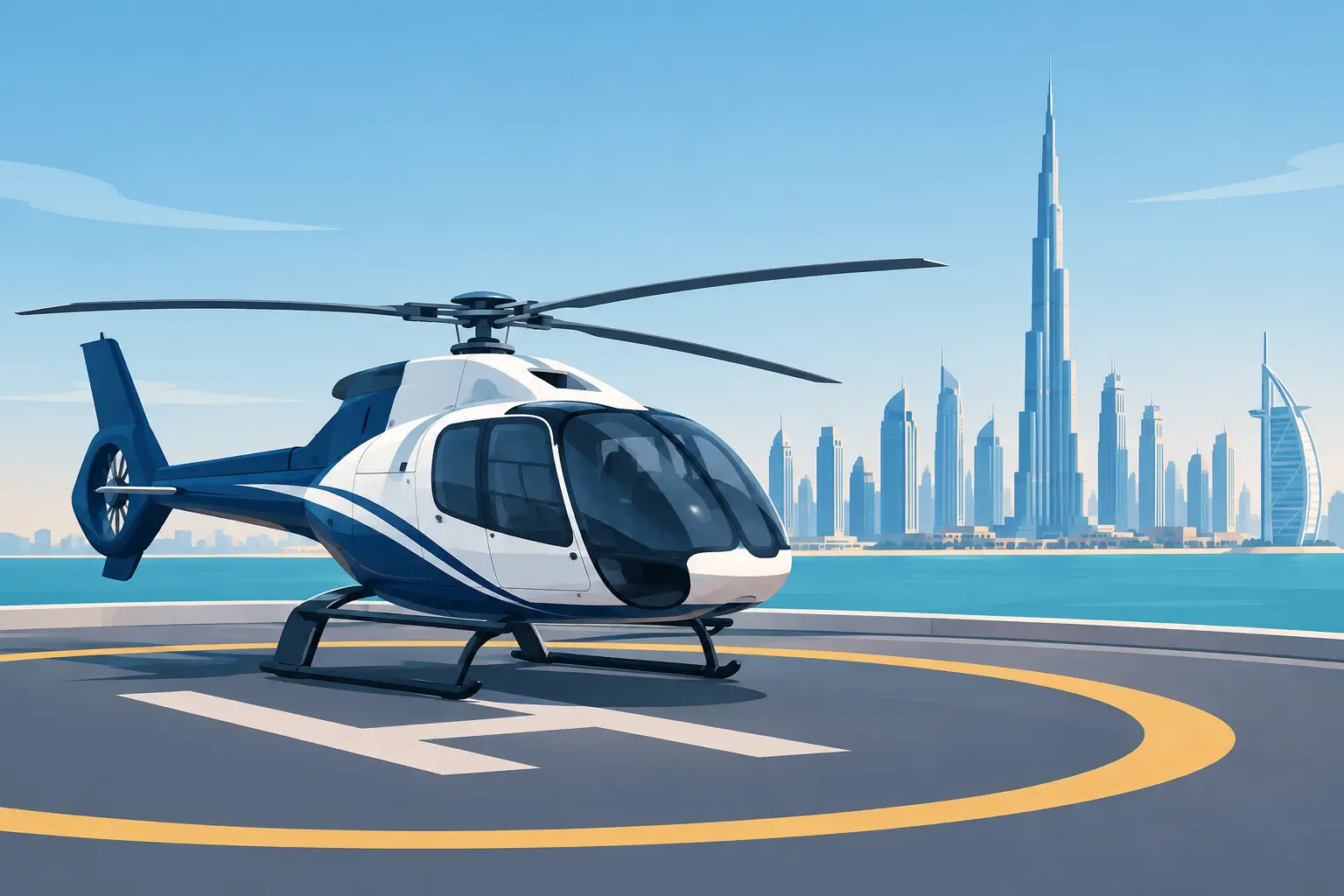
A Dubai helicopter ride can place Palm Jumeirah, Burj Khalifa, the World Islands, and the sparkling Arabian Gulf in one breathtaking view. Before that memorable lift-off, however, one practical detail matters: Dubai helicopter weight limits. They are not a formality at check-in. Passenger weight helps the flight team plan a safe, balanced aircraft for every scenic journey.
For travelers planning a special city experience, the good news is simple: most guests can fly comfortably. The key is to read the tour’s stated requirement before booking, provide accurate details, and contact the operator early if anyone in your party is near or above the published limit. A little advance planning keeps the focus where it belongs – on the magic of seeing Dubai from the sky.
Why Dubai helicopter weight limits exist
Helicopters are designed around precise performance calculations. Unlike a large commercial airplane, a sightseeing helicopter has a smaller cabin, fewer seats, and a carefully managed center of gravity. The pilot and ground team consider the combined weight of passengers, fuel, safety equipment, and weather conditions before departure.
Weight distribution is just as relevant as total weight. A group may fall within the aircraft’s overall passenger allowance, yet still need a particular seating arrangement to keep the helicopter balanced. This is why operators may assign seats at check-in rather than allowing guests to select them freely.
Dubai’s warm climate also plays a part. Hot air is less dense than cool air, which can affect a helicopter’s lifting performance. Operators account for local conditions, flight duration, fuel needs, and the route being flown. These procedures are part of professional aviation planning, not a reflection on any individual guest.
What is the usual passenger weight limit?
There is no single Dubai helicopter weight limit that applies to every tour. The exact rule depends on the helicopter model, number of passengers, route, and operating procedures of the company running the flight.
Many sightseeing operators publish an individual passenger guideline or maximum, often somewhere around 110 to 140 kilograms, which is approximately 242 to 309 pounds. Some flights use a lower planning limit, especially when a full cabin is booked or conditions require stricter load management. Other operators may be able to accommodate a higher individual weight when the remaining passenger weights and available seats allow it.
That range should be treated as a planning reference, not a promise of acceptance. Your booking confirmation and the operator’s current terms are the final authority. If your weight is close to a stated threshold, ask before paying for a nonrefundable experience. The team can explain whether the flight can be arranged safely, whether an extra seat may be required, or whether a different departure time or aircraft is a better fit.
Total cabin weight matters too
A helicopter’s limit is rarely based on one passenger alone. A couple traveling with two children may have a very different cabin calculation from a group of four adults, even if both parties book the same tour. Baggage, camera equipment, and personal items can also be considered, although most helicopter sightseeing flights allow only minimal belongings in the cabin.
For this reason, do not assume that a friend’s previous flight confirms your own eligibility. Aircraft assignments and daily operating conditions can change. Giving the operator the correct information allows them to create the safest possible seating plan before you arrive.
What happens at helicopter check-in?
Expect a smooth but structured preflight process. Guests usually arrive ahead of their scheduled departure for identification checks, a safety briefing, and seating arrangements. The ground team may weigh passengers discreetly, sometimes with carry-on items included, to confirm the flight manifest.
This final check protects everyone on board. If the recorded weight differs significantly from the information provided at booking, the operator may need to adjust the seating plan. In some cases, a guest may need to purchase an additional seat, move to another departure, or be unable to fly if the aircraft cannot operate within its limits.
That possibility can feel disappointing, particularly when a helicopter tour is the centerpiece of a Dubai itinerary. It is also why accuracy is the most helpful thing you can offer. Be realistic when entering passenger details and avoid rounding down. The staff are there to get you airborne safely, not to make the process uncomfortable.
How to book confidently if you are near the limit
Travelers close to a published weight restriction should not wait until the day of their flight to ask questions. Contact the tour provider before booking, or immediately after booking if the booking form does not request passenger weights. Share your approximate weight honestly and ask whether the limit is individual, combined, or subject to seat availability.
It also helps to ask whether an extra seat is required above a certain threshold and whether that seat carries an additional charge. An extra seat can give the operations team more flexibility for cabin balance and personal comfort, but it is not automatically available on every departure. Private helicopter charters may offer more control over passenger arrangements, though they are usually priced differently from shared sightseeing flights.
If your group has varied body types, book early. Early reservations give the flight team more options to organize seats and suggest a suitable time. Morning departures can be attractive for more than just softer light over Dubai’s skyline: temperatures are generally milder than later in the day, which may support operational flexibility. Still, only the operator can confirm what works for a specific flight.
Packing and comfort on a scenic flight
Helicopter cabins are intimate by design. Wear comfortable clothing, secure loose accessories, and bring only essentials such as a phone, sunglasses, and required identification. Large bags are normally not suitable for a sightseeing helicopter, both for space and weight reasons.
If you are carrying professional camera gear or traveling with a young child, mention this when confirming your reservation. A child may need to meet a minimum age requirement or occupy a seat, depending on the operator’s rules. Pregnancy policies, mobility assistance, and medical considerations also vary, so direct confirmation is always the sensible route.
Your view may depend on the assigned seat, but every passenger gets an extraordinary perspective that is impossible to recreate from the ground. Rather than focusing only on a window position, listen closely to the briefing, keep your camera ready before takeoff, and enjoy the changing scale of Dubai’s landmarks as the city unfolds below.
Dubai helicopter weight limits and group bookings
Shared helicopter tours are an exciting choice for couples, families, and friends who want a high-impact Dubai highlight without arranging a private aircraft. They also require flexibility. Seats are allocated around safety calculations, so members of the same group may not always sit together or in their preferred positions.
For celebrations, proposals, or larger family trips, discuss your priorities during the inquiry stage. A private flight may be worth considering if flying only with your own group matters most. On the other hand, a shared flight can be the more practical choice when the goal is simply to experience Dubai’s iconic skyline from above.
The trade-off is clear: private options can offer greater control, while shared tours are generally more accessible and operate on fixed schedules. In either case, accurate passenger information gives the aviation team the best chance of delivering the experience you planned.
Quick questions before you fly
Can I bring a backpack on a Dubai helicopter tour?
Usually, only small personal items are permitted, and larger bags are often stored or left behind. Confirm the operator’s baggage policy in advance, especially if you are heading to another activity immediately after the flight.
Will I be charged for an extra seat?
Possibly. If your weight exceeds the operator’s stated threshold or affects safe seat distribution, an additional seat may be required. The price and availability depend on the operator and departure.
Can the operator refuse boarding because of weight?
Yes. Aviation safety requirements must come first. Providing accurate details before your travel date greatly reduces the chance of an unexpected issue at check-in.
A helicopter flight is one of Dubai’s most unforgettable adventures, from the elegant curve of the Palm to the desert horizon beyond the city. Confirm the weight policy early, arrive ready for the briefing, and let the professional flight crew take care of the details while you enjoy a view that stays with you long after landing.